

Authenticity in the AI Era: Lessons from Charlotte's Tech Leaders
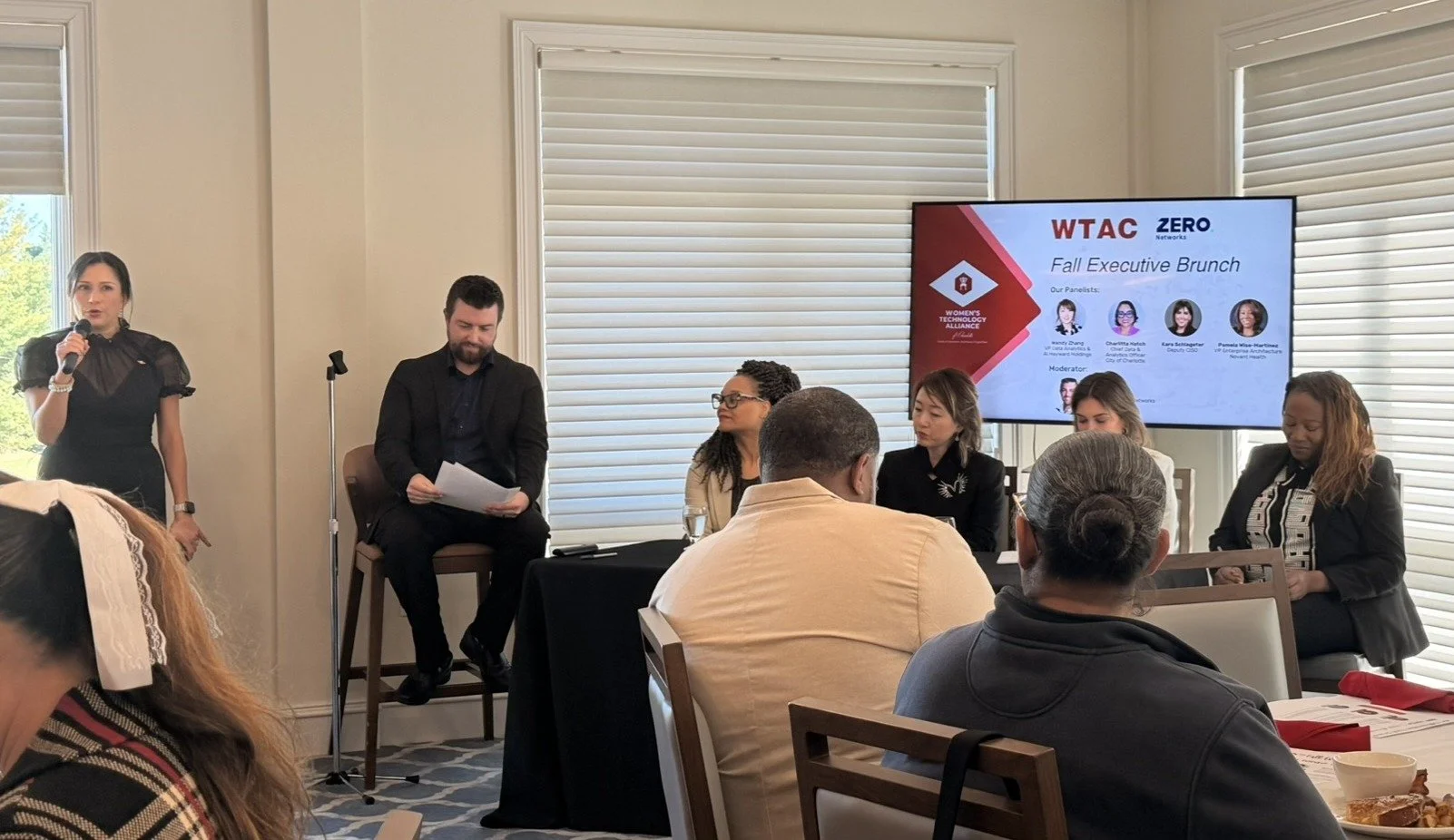
Insights from the Women's Technology Alliance Panel
One of the best things about moving to Charlotte last year? The diversity I see in our tech, cybersecurity, and AI communities. It matters. It goes a long way.
We need awareness of the people we serve, recognition of our blind spots, and the courage to have critical conversations—not despite the challenges of this moment, but because of them. Technology should increase our knowledge, not inherit our ignorance.
Co-hosted by my friends at Zero Networks, Friday's Women's Technology Alliance of Charlotte panel on "Authenticity in the AI Era" exemplified this perfectly. Three insights that every tech leader should consider:
EXPLAINABILITY ISN'T OPTIONAL
Chris Boehm (Zero Networks): While at Microsoft, Chris built a generative AI and machine-learning feature with 99% accuracy. The Fortune 100 client shut it down immediately because it didn't explain its reasoning. They didn't care about accuracy—they cared about trust.
TRUST IS THE FOUNDATION
Charlitta Hatch (City of Charlotte): The City of Charlotte's 311 contact center handles thousands of resident calls. Despite the efficiency gains, the city rejected agentic AI for this use case—not because it wouldn't work technically, but because losing public trust would be catastrophic. When dealing with citizens and government services, transparency and human oversight aren't optional. Even one bad experience or news story about 'robots replacing people' could undermine years of community trust-building. Instead, the city is leading with an AI literacy effort internally and within the community before launching initiatives.
AI DOESN'T CREATE BIAS—IT REFLECTS IT
Wendy Zhang (Hayward Holdings): AI doesn't hallucinate or create bias on its own—it acts as a mirror reflecting what already exists in our world, our data, and our systems. The bias is already there in society; AI simply reveals it. The real question is whether we're willing to confront what that mirror is showing us about the systems we've built.
The Pattern
The pattern across all three: enterprises need AI that explains itself, operates within guardrails, and maintains human oversight at critical decision points.
These are some of the gaps I'm committed to addressing in everything I advise and build at Bakari Intelligence and Flowchestra—transparent orchestration, human-in-the-loop controls, complete auditability. Too often, governance is overlooked in favor of the flashy.
Thank you to the moderator, other panelists (Pamela Wise-Martinez of Novant Health, Kara Martin Schlageter), and Women's Technology Alliance for creating spaces where these critical conversations happen. This was my first WTA event, and definitely won't be the last. Having come from an amazing woman-owned MSSP with a diverse leadership team, I appreciate being welcomed into spaces like this.
-Raum